
Assembly
How parts are joined. Every fastener decides whether a part can ever be repaired, moved or used again.
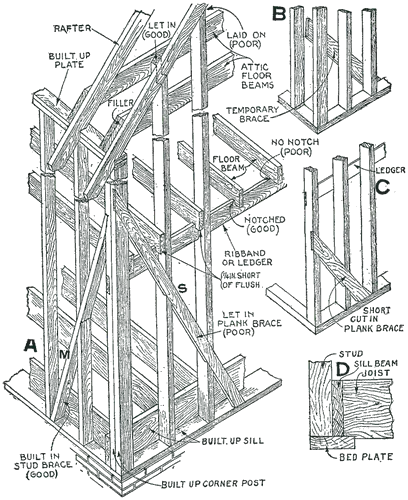
 one fastener at a time
The stage
Assembly is the moment a pile of parts becomes a building. It is also the moment most of the building’s future is settled, one fastener at a time.
What the usual way assumes
That the best joint is the fastest and most forgiving one. Glue, foam and ringed nails are cheap, quick and hide a poor fit. So most of a modern house is, in effect, welded to itself.
What we do instead
We grade every joint on a ladder, from cast-in-place at the bottom to parts that simply lift out at the top. The rule is to use the lowest rung that does the job, and to write down why. The ladder is explained here.
We keep the building’s layers apart. Structure lasts centuries, cladding decades, wiring and pipes a few years. Nothing short-lived may be fastened through something long-lived. More on the five layers.
And we draw the building coming apart as well as going together. If freeing a window takes more than about five steps, the detail is redrawn.
What we don’t know yet
Where the honest limits are. Walls that resist earthquakes and walls rated for fire are tested as exact recipes of nails, boards and sealant. Change the fastener and the rating is gone. We accept those permanent parts, keep them few, and say so plainly.
Questions at this stage
Field Notes
AssemblyComponents
Every nail is a decision
Whether a part of a house can ever be repaired, moved or used again is settled by how it was fastened. A six-rung ladder makes that choice visible.
AssemblyMaintenance
Five layers, five lifespans
A building is not one thing that ages at one speed. Keep its fast parts from being trapped behind its slow ones, and most demolition never has to happen.
AssemblyMaterials
Twelve swaps
Twelve ordinary building details, each beside a version that can be taken apart again, with what it costs and what to watch for.